Book Series
I am probably not 100% neurotypical. There are places in my life where my atypical traits show more than others. One such place is book covers.
Specifically book covers for a series. Iain M. Banks wrote 9 “Culture” novels. I have 7 of them published by Orbit books, that all use the same color palette and same overall design. The last two, even though they are from Orbit, not only have a different aesthetic, they are a different size too. I know this is a small thing, but it bothers me.
Makes me wish there was a way to order books with a specific cover/jacket design.
On a similar note, I’m glad I bought “Wool” long before the Apple TV “Silo” television show. My cover is the original, and not one inspired by the show. I’m pleased with the show’s interpretation of the story, but I don’t need marketing/branding on the cover of the book.
Macos ControlCenter
The WiFi icon in my menu bar has been gray for sometime now, regardless of signal strength or connection. Some glitch in the Matrix no doubt. The solution I found is to restart the “ControlCenter”, i.e., the right-hand end of the menu bar.
killall ControlCenter
At least for now, my WiFi icon is working as expected.
Concerts
On July 20th I’ll be in Chicago to see the Rust “50 Something” tour. I never had the opportunity to see them with Neal Peart. All the reviews of the 50 Something tour have been good, so I am excited to see them. In September I’ll be in Boston to see the same tour a second time. I’ve only done that once before; in the 1980s I saw the same Genesis tour twice.
Here, in order of concerts attended is my list of shows seen.
| Artist | Concerts |
|---|---|
| Genesis | 6 |
| Peter Gabriel | 5 |
| Rush | 2 |
| Phil Collins | 1 |
| Yes | 1 |
| Kansas | 1 |
| Foghat | 1 |
| Blue Oyster Cult | 1 |
| Heart | 1 |
| John Melloncamp | 1 |
| - | - |
| Yo-Yo Ma | 3 |
| Itzahk Perlman | 1 |
| Yamoto Japanese Drums | 1 |
Intonation Blues
There are two broad categories of music instruments: fixed intonation and variable intonation. Fixed intonation instruments are keyboards, fretted string instruments-anything where you cannot play out of tune.
Variable intonation instruments require the player to not only master playing the instrument, but also master producing notes, music, that is in tune.
The violoncello, or cello, falls firmly in the variable intonation camp. Playing something, anything, in tune is astonishingly difficult. Over time you develop muscle memory of where a particular note is. Unfortunately, if you don’t pay attention, you may develop muscle memory that is out of tune.
I struggle with maintaining correct intonation. There are two axis for left hand movement on a cello. Across the fingerboard, from one string to another, and up and down the fingerboard to different regions of the strings. The sideways, or horizontal changes are easier for me to maintain good intonation. “Easier” being a relative term. You have to maintain a good hand shape, and move perpendicular to the strings, not slightly diagonal, and you need to be aware that while playing your strings will drift from being in tune. Meaning the note that should be a perfect 5th above or below its neighboring string, may in fact be out of tune, requiring you to adjust ever so slightly to stay in tune.
Vertical movement, or shifting, adds a new layer of complexity to intonation. You can no longer use your left hand thumb as an anchor, you have to move everything, and land on the correct note. In tune. Oh, and the farther from the nut (top of the fingerboard) you get, and the closer to the bridge, the closer the individual notes are to each other. The finger spacing in 1st position is much wider apart than in 4th or 7th position.
Intonation can be altered merely through more or less pressure on your finger. More pressure compresses the flesh on your finger tip, making it wider, altering the pitch.
I’m not trying to make excuses or complain, I’m acknowledging that intonation is a difficult, fundamental skill on the cello. One that requires daily care and feeding.
This summer I’ve been trying to rebuild some of my weaker foundation skills. Playing fast being the principal goal, and intonation being the other goal. A day or two ago I decided to play a one octave scale. Using my tuner, I didn’t allow myself to go past a note, until I could play it in tune. If I missed, I had to start over, or at least start from the previous note again.
A one octave scale employs two strings (setting aside one string scales). Two strings gives you two in tune notes for free, assuming your cello is in tune. Starting a C major scale on the C-string, after ten minutes I still couldn’t play all eight notes in tune, one after the other.
So now I am starting each practice session with 10 minutes of dead slow scale work, aiming to play all eight in a row, in tune. Once I can do the scale ascending, then I’ll add descending to the mix. My goal is twofold. First I want to retrain my fingers where the correct pitch is. Second I want to learn to hear what the correct pitch sounds like. Not “close enough” and not “I’ll fix that later”. Correct or start over.
I resume lessons in about 5-6 weeks. Call it 35 days. I wonder if in 350 minutes of focused practice I can learn to play a scale in 1st position accurately.
When you’ve got rid
of all the mosques
But the costs
of life still rise
and you’ve built
your fortressed borders
but the NHS still dies
and the Muslims are all gone
and your town’s a wall of white
but corporate vultures
are still pillaging
every facet of our lives
who will you blame then?
What will you have gained?
A badge for barbarism
against a backdrop of decay
Amaze Amaze Amaze
Andy Weir’s “The Martian” was the first book I ever read twice in a row. Andy Ihnatko recommended it on Twitter (remember when Twitter was good?) and so I checked it out from the library. I could not put it down. And I reread it immediately after finishing it.
“Artemis”, his second book, is good, but it suffers from having to follow “The Martian”.
“Project Hail Mary” is superb. I don’t think it is better or worse than “The Martian”, it is as good in different ways.
The movie version of “The Martian” is one of the better book-to-movie efforts. Like all movies, a certain amount of compression has to happen to fit the book into roughly two hours of movie. It is one of my favorite movies.
I saw “Project Hail Mary” a couple days ago in the theater. It is as good as everyone says. I think the movie is as good a representation of this book as “The Martian” movie was to its book.
In the words of Rocky, amaze amaze amaze.
Tonight while we were having dinner Sibylle showed me on her phone that you can now buy or rent “Project Hail Mary”. Guess what we watched this evening?
For all the space and technology and science in Andy Weir’s books, the humanness of the stories are the real draw. Go see “Project Hail Mary”, or rent it, or buy it, and you too will say amaze, amaze, amaze.
Menu Bar Denizens
From right to left (at the moment, anyway) here are the things in my Menu Bar.
Apple Menu Bar Items
Day Date Time
I have it set to show a three letter abbreviation for the day of the week, and
also month. The time is 12h, i.e., AM and PM.
Settings
Standard “control panel” drop down dialog. I don’t think I’ve even modified
what appears here.
Wireless
It’s a laptop that is always connected via WiFi. I like that Option-clicking on
the icon provides detailed connection information.
Bluetooth
Headphones, AirPods, and keyboards are the devices I connect with over
Bluetooth.
Battery
When my battery usage seems to be higher than normal I like that this tool
gives you a list of the significant energy users.
Volume Mostly I like that at a glance I know whether or not my speakers are muted.
Time Machine
Once per hour snapshots of my data. Nice.
Focus Mode
I make good use of focus modes. I have a geographic one for my weekly cello
lesson. If the day or time of the lesson changes, the focus mode still works. I
also have a weekend one that quiets notifications from most apps. I use Apple’s
Sleep tracking, which has its mode, and I have one that I turn on when I
practice cello to prevent interruptions.
Passwords
I’m all in on the MacOS Passwords app. I used 1Password for years, but the
increasing subscription cost and feature creep wore me out.
Application Menu Bar Items
Take Five
Allows me to keep tabs on what is currently playing. Nice that it recognizes
YouTube videos, movies, and music.
SpameSieve I started using SpamSieve soon after getting my Titanium PowerBook G4 in 2002. Still use it for my domain email.
Tailscale I have Tailsacle on all my personal computers, and I have those IP addresses in my ssh config with aliases so it is simple to remote into any other computer from the one I’m one. Exit mode is great when traveling to route my traffic through my home connection.
Maestral
A Dropbox GUI replacement. I hard use Dropbox any more. When I do, I use
Maestral rather than the device limited official client.
Podman Desktop
An alternative front end to Docker. Typically I only use it for databases when
I’m toying around with some project that needs a data store. Often it isn’t
even running.
RepoBar
The newest member of my Menu bar is RepoBar. It gives lets me monitor my GitHub
repositories quickly and easily.
Even with 15 Menu bar items I still have about an inch of room before things would disappear under the dreaded notch. Should I ever get to that point I’ll look into Bartender or similar to organize the denizens.
Age Gating
I watch a bunch YouTube channels. Everything from sailing to woodworking to flying to programming. Frequently the YouTube algorithm suggests something I find interesting enough to watch, but not interesting enough to add to corpus of data YouTube has about me.
When there is a video or short that I want to look at without being “me”. I copy the link and open a private window and watch it there. This worked famously. Until today. This morning when I tried this trick I was presented with a YouTube sign in screen. Refreshing and trying again didn’t help. Some quick research informed me that YouTube has been rolling out age gating.
(I’m not going to get into the smoke-and-mirrors aspect of “protecting youth by requiring they enter an age”. It is really about tracking.)
Fortunately I collect email addresses. So I dusted off a dormant one and used that to sign into YouTube in another browser. My watching habits are still being tracked, and with some work you could trace your way from the second account back to me.
At least I’m not polluting my primary YouTube feed with one-offs.
Repairing the Ruins: Why AI Cannot Replace Education ⧁
For years I have thought that, if I were a teacher, I would allow the use of any source material the student desired, as long as it was attributed fully and correctly. Even before generative AI it was possible to “out source” creative work to some distillation of another’s work. Generative AI merely makes that outsourcing friction-less.
The teacher’s role accordingly becomes more important in the age of AI, not less. A real teacher is not merely a distributor of content. A real teacher is an experienced guide in inquiry: someone who knows what the student has not yet seen, what distinctions must be made, what confusion needs exposing, and what question should come next. The best classroom is not a transfer of information from one container to another. It is a living act of thought. That is why seminar, disputation, laboratory, tutorial and serious conversation retain their force even when information itself becomes cheap.
Jujutsu History Template
Jujutsu Version Control
Recently I’ve been using Jujutsu
or jj for version control. It is, in effect, an alternate front-end to Git.
There are any number of articles,
tutorials and other online resources that can explain the finer
details.
One feature I’ve been exploring more lately is Jujutsu’s ability to use templates to control how output is presented.
Compact history
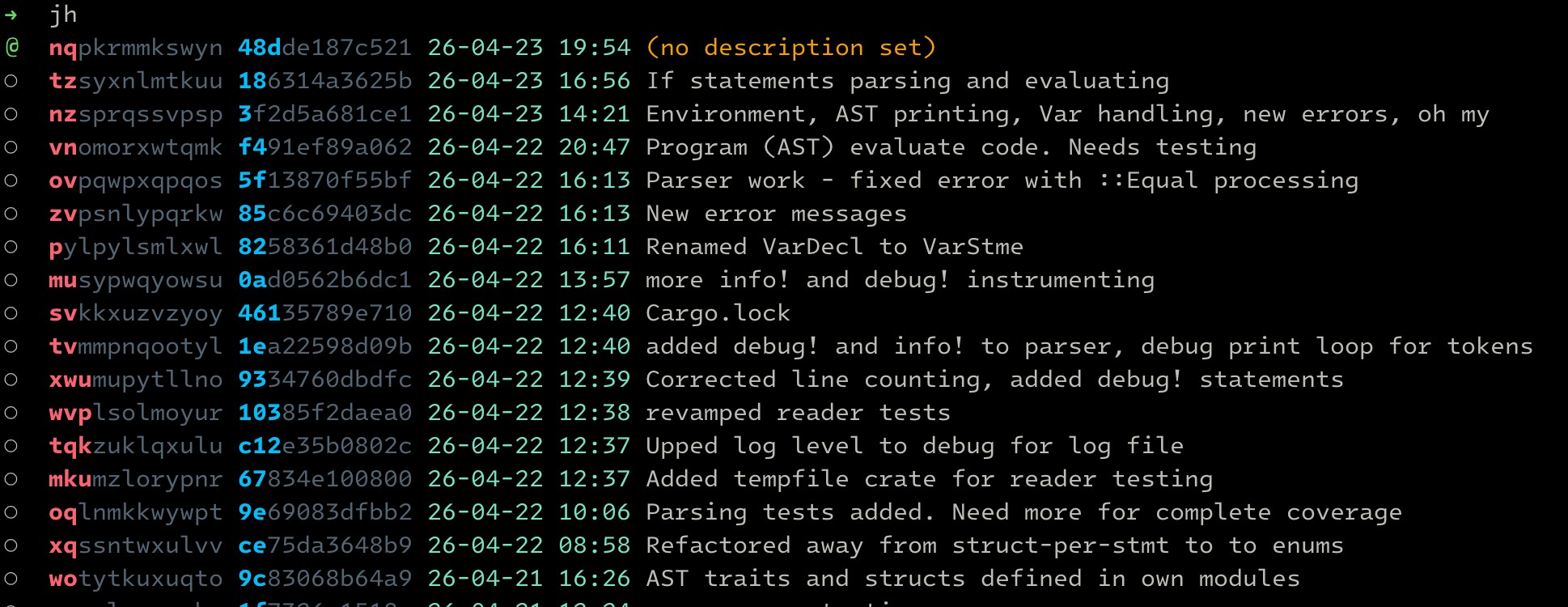
I like a one-line history. jj provides that ability, but I was unhappy with the column order. Templates to the rescue. The following template shows the change id, then the commit id, the date and time, the author, and finally the description.
For the date and time I like to use the .ago() option to get relative time
offsets. However the width of that information is variable, which ruins a nice
table-like appearance. So I’ve opted for a 12-character format with a 24 hour clock.
The author on all of my own repositories is me, so having my name displayed on each line seems silly. The template compares the author email on the commit to my email address, and only displays the name if the two are different. Nice.
Here’s the template:
history = ["log", "-T", '''
  change_id.shortest(12)
  ++ " " ++ commit_id.shortest(12)
  ++ " " ++ committer.timestamp().format("%y-%m-%d %H:%M")
  ++ if(author.email() != "mark@zanshin.net",
      " " ++ author.email().local(),
      "",
    )
  ++ " " ++ if(description,
      description.first_line(),
      label("hint", "(no description set)"),
    )
''']
Put that into the [aliases] section of your configuration TOML. I have a bash alias setup to trigger this template. The results look like this: